Barriers to Active Listening (https://keydifferences.com/difference-between-active-listening-and-passive-listening.html)
The barriers to active
listening are represented below:
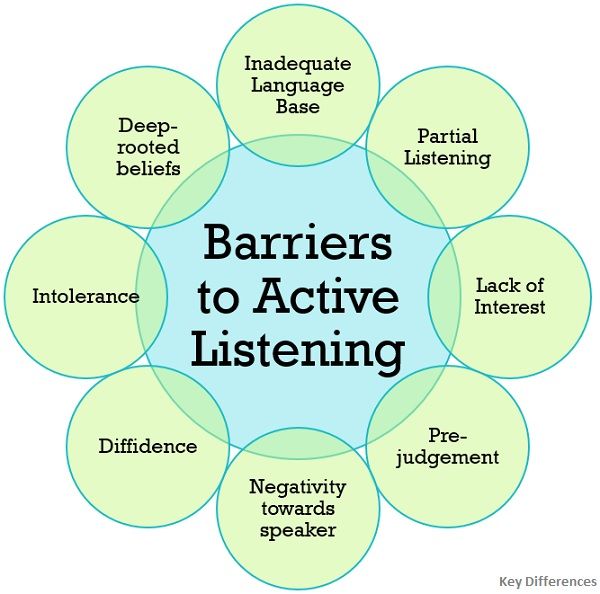
Now, let us discuss
them one by one:
|
Inadequate Language Base |
Active listening requires good language base so as
to understand the speaker clearly. Even if the listener attempts to
participate in the process of communication, if the language base is poor, it
will act as a deterrent in actuve listening. For example: Suppose
a teacher gives lecture in English, but the student is not fluent in English,
so here inadequacy of language will act as a barrier. |
|
Partial Listening |
Partial listening is when people are involved in
multiple tasks at the same time, which distracts them easily. |
|
Lack of interest |
Lack of interest in the topic of discussion is one
of the major factor which acts as a barrier to the active listening
process. For example: If one person is saying something to
another person about politics, and the receiver is not at all interested in
it, so there are chances that he will not pay his attention to what the
speaker is saying. |
|
Pre-judgement |
There are instances when a listener pre-judges or
forms his/her opinion about the speaker on the basis of his appearance,
attire, accent, status, and mannerism. However, these biases differs person
by person. |
|
Negativity towards the Speaker |
Listener's metal, emotional and psychological
perspective towards the speaker, also plays a major role in active listening.
This is because, if a person does not like the speaker or disapprove his
ideas, then the chances of distortion or misinterpretation of the message is
quite high. For example: Suppose the speaker and listener believe
in different ideologies, so the listeners usually exhibits animosity, and
also continues to disagree with the speaker's views. |
|
Diffidence |
Lack of confidence results in diffidence. That is
why many listeners tend to understand their potential and decide beforehand
that they won't be able to understand what the other person is going to
speak. This often affects the process of communication. |
|
Intolerance |
Some listeners are intolerant in nature, which may
be because he/she is over enthusiastic or impatient. And that is why he/she
feels that speaker is slow in communication. Hence, before the speaker could
finish speaking, the listener advances questions and also interuppts while
he/she is speaking. And so the listener generally assumes everything in
advance, which prevents him/her from active listening. |
|
Deep-rooted beliefs |
Some people are narrow minded, due to their
so-called beliefs, judgement and stereotypes. These beliefs are so strong
that it works as a barrier to new ideas and thoughts. |
Examples
Given below are some
common examples of active listening and passive listening:
|
Active Listening |
Passive Listening |
|
Group Discussion |
Watching TV while eating food. |
|
Students asking questions from the teacher on the
topic explained. |
Listening to someone while operating mobile. |
|
Job Interview |
Listening to the speaker during the presentation. |
Conclusion
In a nutshell,
listening is an attentive process, which requires a person to consciously think
to listen properly. The degree of attentiveness has a crucial role to play in
the process of listening. The difference between active and passive listening
lies in the listener’s attention and involvement in the conversation.
Comments
Post a Comment